Two people, an apprentice and a labrador.

HEYLOLA is a small workshop in Romania. We 3D print to order, on a single printer, and every part goes through our hands before it reaches you.

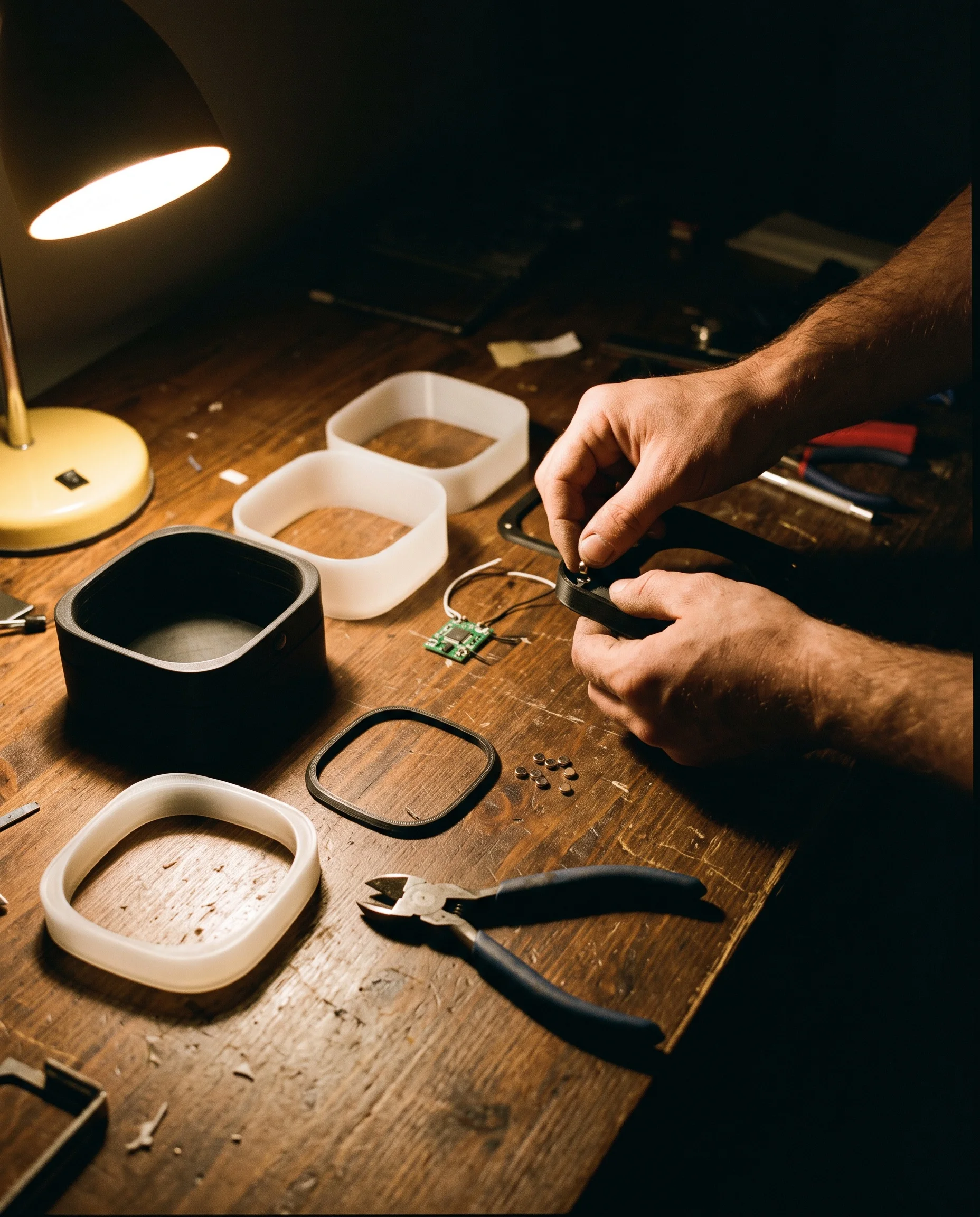
The workbench at night: the lamp's printed parts, a few magnets, a small board and a pair of hands pressing a magnet into a black frame.
The workbench, at night.

Who we are.

Each with their own part of the workshop.

Ovidiu, the form and the brain.

He draws the form and writes the code. He comes from crypto and from security, from where nothing is allowed to break.

STRAT started from his question: why do all smart lamps look like gadgets? He answered on paper, with a 127 millimetre square, the size of a Mac mini, with continuously curved corners and layers on a four millimetre grid, so that any combination looks like a single lamp. He printed the diffuser dozens of times, until one that does not let the LEDs show.

The rest comes from years of building systems for people who put their money into code. That is why STRAT has no account and does not need us in order to work.
Elena, the hands.

She was a dental technician: years of working to tenths of a millimetre, with objects that have to fit perfectly in someone's mouth.

When a part comes out of the printer, she is the first to pick it up: she feels the joint between the layers, checks whether the magnets pull the same in every corner, sands what does not sit right and says, bluntly, what feels cheap.

She is also the one who uses the lamp like someone who did not design it. She gets up at night, puts the phone on top, looks for the button in the web page and notes every second in which she had to think. Her list is the most important piece of paper in the workshop.

The finishes, the colours, how the lid feels when you close it: all of it goes through her before it reaches you. If STRAT feels good in the hand, it is because Elena did not let it be otherwise.

Lola, the name.

Labrador. She does not know the company carries her name, and she would not care.

HEYLOLA comes from the way we call her ten times a day: hey, Lola. When we had to choose a name for everything we do, it was already on the table.

In the workshop she has the hardest job: she stays at floor height. The lamp's sensor is tilted downwards precisely so it can see who is walking on the floor at night, and she is, by far, the most frequent reason the light comes on.

She tests nothing, approves nothing and has not read the manifesto. But every prototype has passed by her nose and, so far, none has been bitten.

Claude, the apprentice.

A language model made by Anthropic and the third one in the workshop.

It has no hands, no taste and does not sleep, so it gets what is left: it wrote this page, started the renders from the lamp's 3D model, generated the videos, checked the firmware code and read the parts list dozens of times. When Ovidiu writes “I don't like it” at three in the morning, it replies in thirty seconds with another version.

It makes no decisions. The form and the code are Ovidiu's, the verdict Elena's. But each of them had, along the way, someone to talk to about the lamp at any hour, and that shortened the road.

We listed it here because we think it is fair to say how we work. What leaves the workshop is made by people, with a helper that does not get tired.

How we work.

Four steps, always the same: paper, printer, hand, and then the object stays yours.

We design objects to be taken apart, not thrown away.

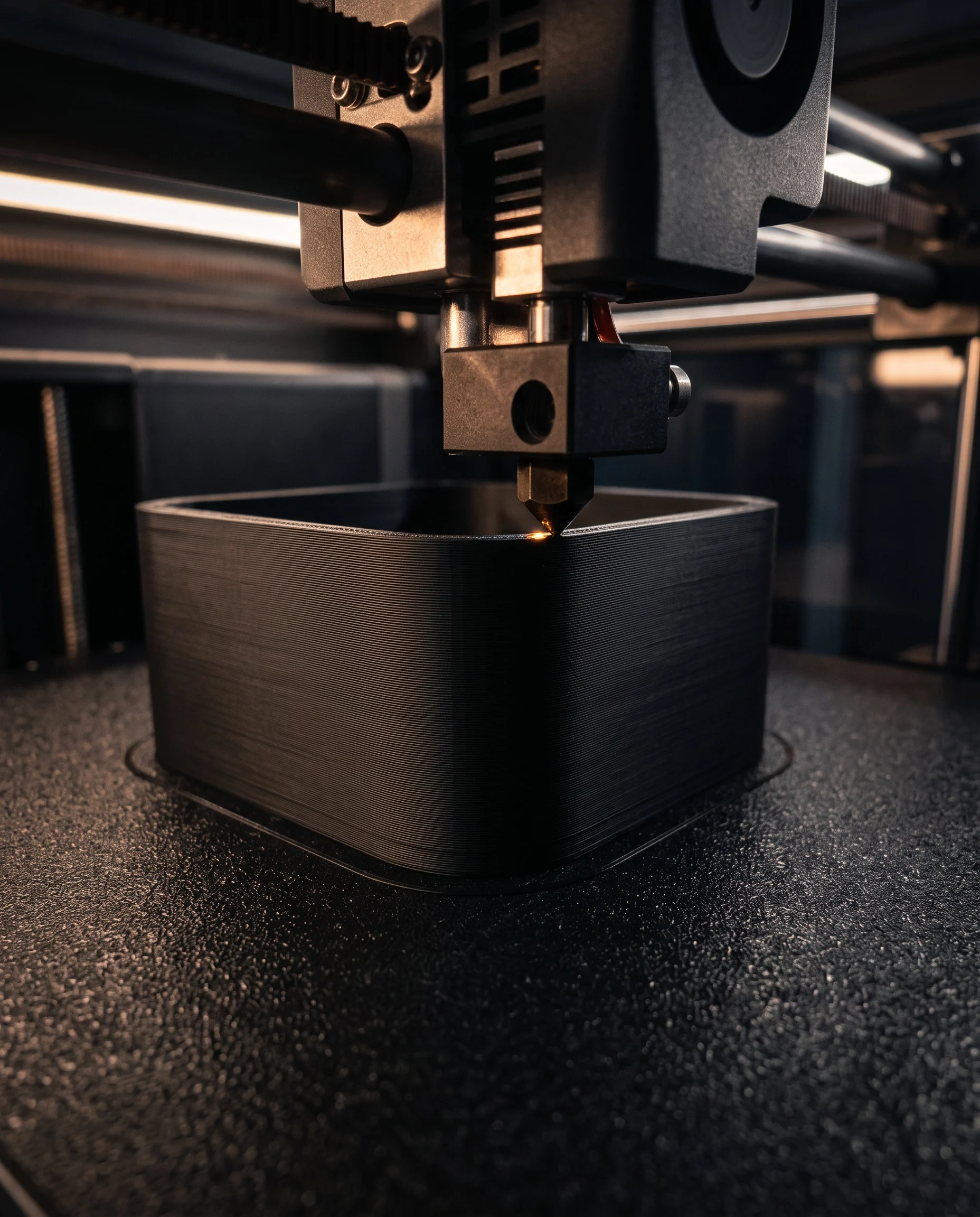
Inside the 3D printer: the nozzle lays a new layer of matte black filament on the lamp's base, on the textured plate.
In the printer: a new layer on the lamp's base.

First on paper.

An object begins with a question.

For STRAT, the question was why all smart lamps look like gadgets. The answer came from dozens of sketches of the same square, until the corners came out right, and from a four millimetre grid on which all the layers sit.

The joint between the layers was drawn three times until it became a fine line, even all the way around. We work slowly, with the object in hand, until there is nothing left to take away.

Then in the printer.

We 3D print in Romania, on a Bambu Lab X2D, and assemble by hand, piece by piece.

We print after you have ordered, in small batches, and we keep no stock. Most parts are made of PLA, a plastic made from plant starch; the lamp's diffuser is PETG.

The objects in the shop start from models by other authors, used under a commercial licence. STRAT is our own design: its diffuser went through rings printed in different materials, placed over the same light and photographed at night, until one that does not show the LEDs and does not swallow the light.

Then in the hand.

Every part goes through Elena's hands before it reaches you.

When a part comes out of the printer, she is the first to pick it up: she feels the joint between the layers, checks whether the magnets pull the same in every corner, sands what does not sit right and says, bluntly, what feels cheap.

She is also the one who uses the lamp like someone who did not design it: she gets up at night, puts the phone on top, looks for the button in the web page and notes every second in which she had to think. Lola stays at floor height and is, by far, the most frequent reason the light comes on.

And it stays yours.

What leaves the workshop no longer needs us.

STRAT runs on ESPHome, with MQTT and a native Home Assistant API, so you can read the code and you can change it. It has no account and sends nothing outside your network. If a part breaks, we replace that part. If in two years you want more light, you add another slice.

And we say things plainly: the images of the lamp are renders, the prototype is in progress, the price does not exist yet. We do not promise what we do not have.

Have a question or a project?

Write to us at ovidiu@heylola.ro. There are two of us, so one of us will answer.